Stock Market Today: Oil Surges Above $90, Nasdaq Drops as Treasury Yields Near 4.8%- September 1, 2026
BullsMeet Market Close — September 1, 2026
September opened with a clear risk-off setup.
Oil surged, Treasury yields climbed, Federal Reserve rate-hike expectations increased, and technology stocks led the market lower.
At the same time, strong after-hours results from Dell showed that AI infrastructure demand remains robust underneath the macro pressure.
Here are the 10 stories that actually mattered today.
1. Oil Above $94 Changed the Market Setup
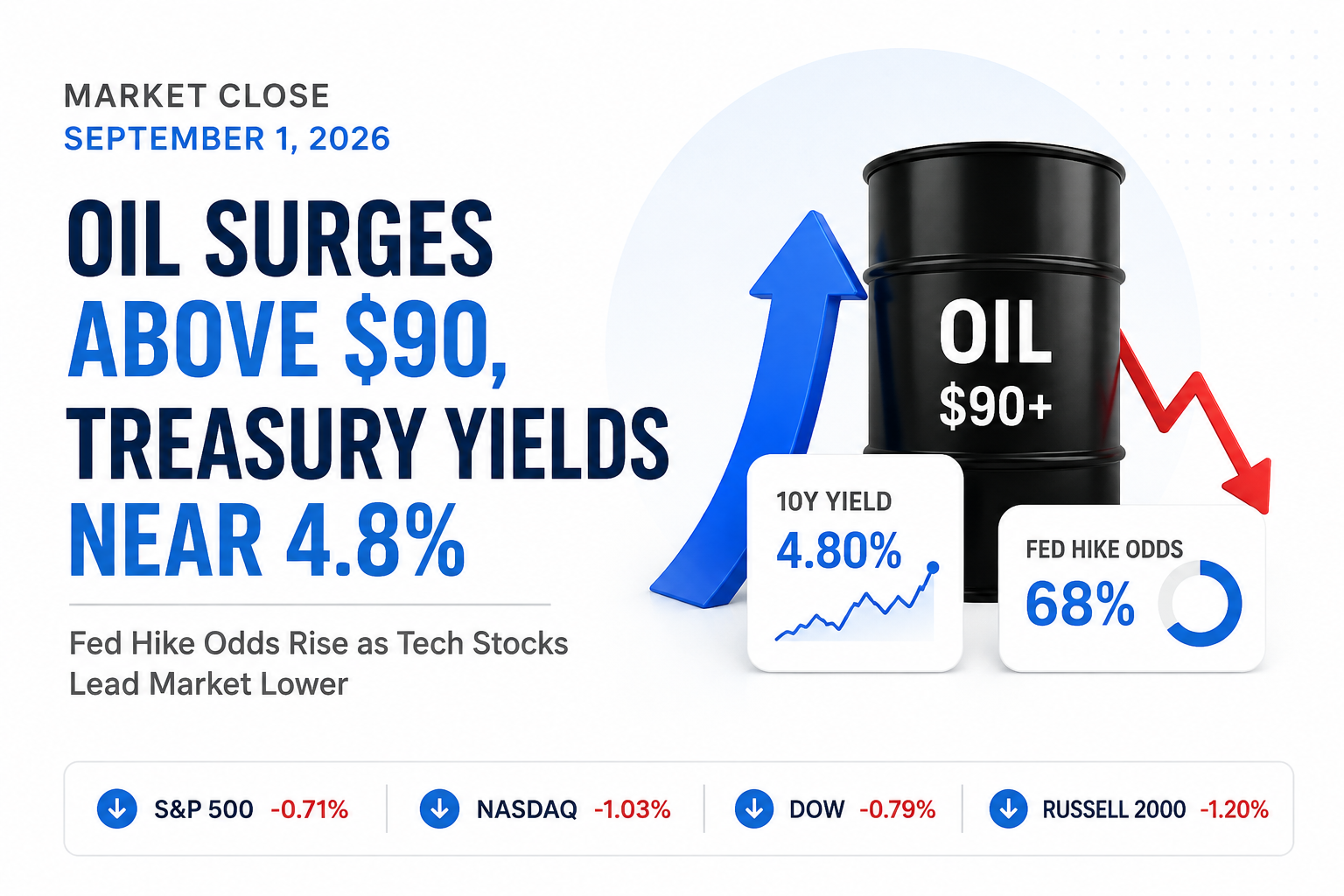
Brent crude surged 4.6% to settle at $94.65 per barrel, while West Texas Intermediate rose 5.2% to $90.22.
Renewed U.S.-Iran fighting around the Strait of Hormuz revived concerns about prolonged disruptions to global energy flows.
The market increasingly faces a difficult macro equation:
Oil ↑ → inflation risk ↑ → Fed hike odds ↑ → Treasury yields ↑ → equity valuations ↓
2. Stocks Closed Broadly Lower
- S&P 500: -0.71%
- Nasdaq Composite: -1.03%
- Dow Jones: -0.79%
- Russell 2000: approximately -1.2%
Declining stocks outnumbered advancing stocks by roughly 2.8-to-1 on both the NYSE and Nasdaq.
The Dow Jones Transportation Average fell 2.5%, highlighting broader pressure from higher fuel costs and tightening financial conditions.
3. The 10-Year Treasury Yield Approached 4.8%
The U.S. 10-year Treasury yield reached 4.798% intraday, its highest level since January 2025.
The move was part of a broader global bond selloff. Japan's benchmark 10-year yield also reached 3% for the first time since 1996.
Higher risk-free yields create additional valuation pressure for long-duration growth stocks, particularly technology companies.
4. September Fed-Hike Odds Rise to Roughly 68%
Markets are pricing approximately a 68% probability of a 25-basis-point Federal Reserve rate increase in September.
That compares with roughly 40% one week earlier and around 35% before Fed Chair Kevin Warsh's recent Jackson Hole remarks.
Higher oil prices make the inflation outlook more difficult and strengthen the argument for tighter monetary policy.
5. Semiconductor Stocks Sell Off
The Philadelphia Semiconductor Index declined 2.1%, with every constituent finishing lower.
Major AI and semiconductor stocks including $NVDA were pressured as investors adjusted to higher Treasury yields.
The selloff appeared primarily macro-driven rather than a result of a sudden deterioration in AI demand.
6. JOLTS Shows a Low-Hire, Low-Fire Labor Market
U.S. job openings totaled 7.271 million in July, slightly below economists' expectations but above a downwardly revised 7.182 million in June.
Hiring declined to roughly 5.05 million and quits also fell, while layoffs remained relatively low.
The data suggest a labor market that remains stable but is becoming less dynamic.
7. Manufacturing Is Still Expanding, But Momentum Slowed
The ISM Manufacturing PMI fell to 54.6 in August from 55.6 in July.
The reading remained above 50, indicating continued expansion, but came in below economists' expectations.
New orders weakened while input prices remained elevated, reinforcing concerns about slower growth combined with persistent inflation pressure.
8. Gold Falls More Than 2%
Spot gold fell more than 2% to approximately $4,342 per ounce, while U.S. gold futures settled 1.9% lower at $4,396.40.
Higher Treasury yields and a stronger U.S. dollar outweighed the potential safe-haven demand created by geopolitical tensions.
9. $DELL Gives the AI Trade an After-Hours Boost
Dell Technologies raised its fiscal 2027 AI-optimized server revenue outlook to $74 billion, up from its previous forecast of $60 billion.
The company also increased its annual revenue outlook to $192 billion and raised adjusted earnings guidance to $25.50 per share.
Second-quarter revenue reached a record $47 billion and exceeded analysts' expectations.
$DELL shares rose roughly 10% in after-hours trading.
The results provide another signal that demand for AI infrastructure remains strong despite pressure on technology-stock valuations.
10. Tomorrow's Big Catalysts: Jobs Data and $AVGO
Wednesday begins with ADP's August private-employment report, where economists expect roughly 45,000 to 47,000 additional jobs.
After the market closes, Broadcom reports earnings.
The report will provide another important read on AI networking, custom silicon demand and hyperscaler capital spending.
$SNOW and $HPE are also scheduled to report results.
Today in 20 Seconds
- S&P 500: -0.71%
- Nasdaq: -1.03%
- Dow: -0.79%
- Russell 2000: approximately -1.2%
- Brent crude: +4.6% to $94.65
- WTI crude: +5.2% to $90.22
- 10-year Treasury yield: intraday high of 4.798%
- September Fed-hike probability: approximately 68%
- Philadelphia Semiconductor Index: -2.1%
- Gold: down more than 2%
- $DELL: roughly +10% after hours
3 Things to Watch Tomorrow
-
ADP Employment
A weak report could reduce some of the market's recent Fed-hike expectations, while a strong reading could push Treasury yields even higher. -
$AVGO Earnings
Broadcom will provide another key read on AI networking, custom silicon and hyperscaler spending. Watch $AVGO, $NVDA, $AMD, $MRVL and $MU for read-through. -
Oil and the 10-Year Treasury Yield
If WTI remains above $90 while the 10-year yield pushes closer to 5%, technology stocks may need exceptional earnings growth to overcome the resulting valuation pressure.
Today macro won.
But Dell's results showed that the underlying AI infrastructure story remains strong. Tomorrow, Broadcom gets the next chance to prove it.
Stocks Mentioned