Stock Market Today: Nvidia Leads Rebound as Oil Stays Above $90, Broadcom Slips After Earnings - September 2, 2026
BullsMeet Market Close — September 2, 2026
Wall Street finally bounced, but the macro risks did not disappear.
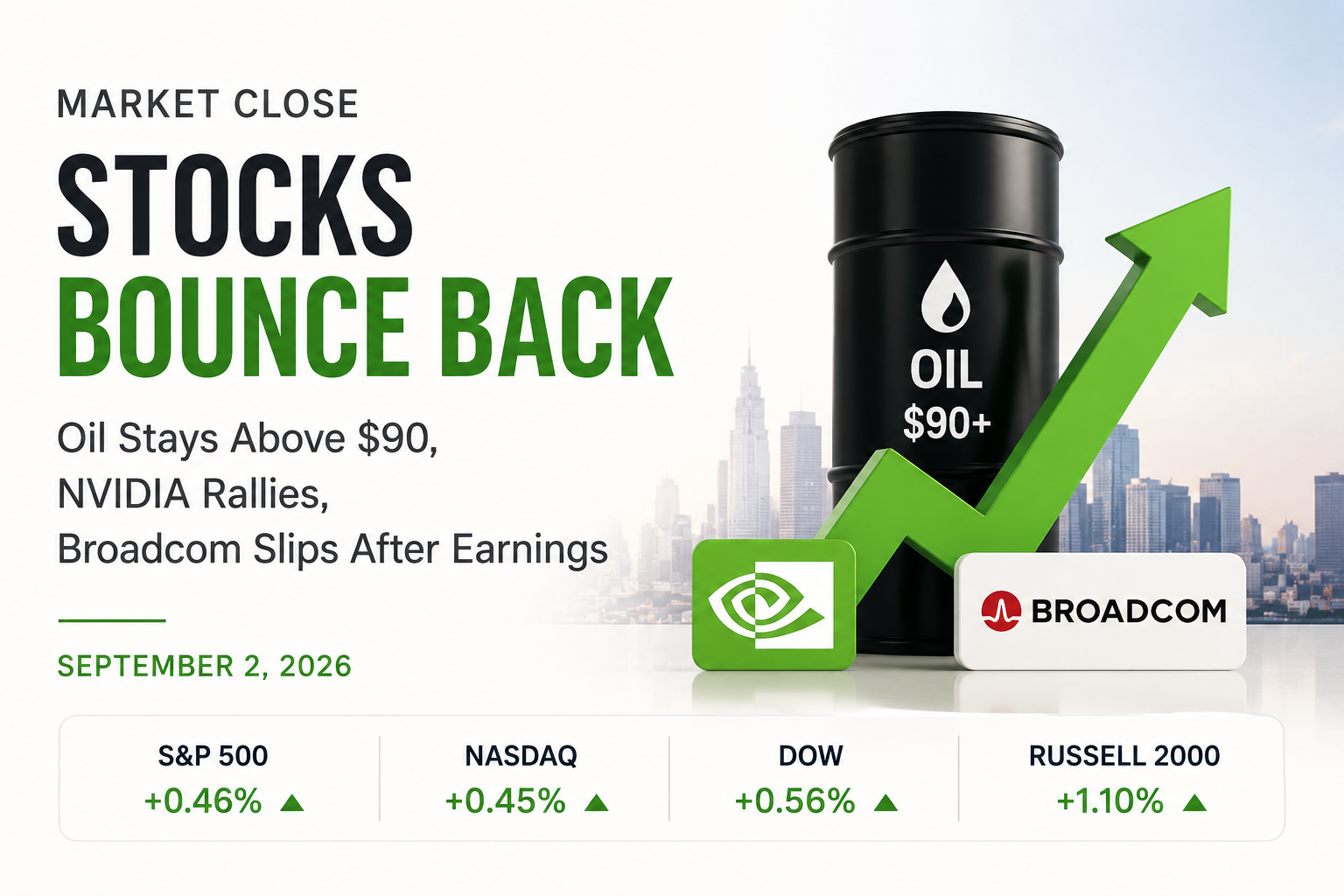
The S&P 500, Nasdaq and Dow all gained ground Wednesday, while small caps outperformed. Technology stocks recovered and Nvidia rallied, but crude oil remained above $90 and labor data showed additional signs of slowing.
After the close, AI-related earnings produced very different reactions across Broadcom, Snowflake and Hewlett Packard Enterprise.
Here are the 10 stories that actually mattered today.
1. Wall Street Snapped a Three-Day Losing Streak
- S&P 500: +0.46%
- Nasdaq Composite: +0.45%
- Dow Jones Industrial Average: +0.56%
- Russell 2000: +1.1%
Small-cap stocks were the strongest major group as investors returned to areas of the market that had been hit hard during the recent rise in Treasury yields.
The rebound did not represent a complete reversal in the macro backdrop, however. Oil remained elevated and Treasury yields were still high.
2. $NVDA Leads the Semiconductor Rebound
Nvidia gained 3.2%, while Micron rose 2.4% and Qualcomm climbed 2.0%.
The move helped the semiconductor sector recover after several sessions of pressure caused partly by rising bond yields.
Investors continue to show willingness to buy weakness in AI-related stocks when the macro environment stabilizes.
3. $DELL Reinforces the AI Infrastructure Demand Story
Dell Technologies rallied after raising both its annual sales and earnings forecasts.
The company now expects approximately $192 billion in annual revenue, up from $167 billion previously, while adjusted earnings guidance increased to $25.50 per share.
Quarterly revenue reached a record $47 billion, up 58% from a year earlier.
The results reinforced expectations that demand for AI servers, networking, storage and data-center infrastructure remains extremely strong.
4. Oil Remains the Market's Biggest Macro Risk
Brent crude settled 1% higher at $95.63 per barrel, while West Texas Intermediate rose 0.9% to $91.01.
Renewed U.S.-Iran military strikes continued to threaten global oil supplies and restricted shipping through the Strait of Hormuz.
The market continues to face a difficult chain reaction:
Oil ↑ → inflation risk ↑ → Fed pressure ↑ → Treasury yields ↑
5. U.S. Crude Inventories Drop Sharply
U.S. crude inventories fell by 4.5 million barrels last week.
Analysts surveyed by Reuters expected only about a 1.1 million-barrel decline.
That suggests the oil rally is being supported not only by geopolitical concerns but also by a tighter inventory backdrop.
6. ADP Employment Comes In Below Expectations
Private employers added only 38,000 jobs in August, below economists' forecast for a 48,000 increase.
July's reading was revised slightly higher to 46,000.
Education and healthcare added 45,000 positions, while manufacturing lost 17,000 jobs and professional and business services shed 16,000.
The data are consistent with a labor market that remains stable but is losing momentum.
7. The Fed Is Getting Conflicting Signals
Slower hiring would normally argue for easier monetary policy.
However, oil above $90 and persistent inflation pressure make the Federal Reserve's job more complicated.
Markets continue to assign roughly a 64% probability of another Federal Reserve rate increase at the September meeting.
That makes Friday's official employment report particularly important.
8. Gold Rebounds
Spot gold gained more than 1% to approximately $4,376 per ounce after Treasury yields and the U.S. dollar eased from recent highs.
December gold futures settled around $4,414.60.
Gold remains caught between supportive geopolitical uncertainty and pressure from elevated real interest rates.
9. $SNOW Surges While $AVGO Falls After Hours
Snowflake shares surged more than 20% in extended trading after the company increased its annual product-revenue forecast to $6.07 billion from $5.84 billion.
Quarterly product revenue increased 37% year over year to $1.49 billion.
Broadcom moved in the opposite direction.
The company reported third-quarter revenue of $29.59 billion and adjusted earnings of $3.32 per share. AI-chip sales more than tripled to $16.7 billion.
However, Broadcom projected fourth-quarter revenue of approximately $34.8 billion, slightly below Wall Street's roughly $35.03 billion expectation.
Shares fell more than 3% in after-hours trading.
The divergence shows how high investor expectations have become for companies exposed to AI.
10. $HPE Raises Guidance but Shares Fall
Hewlett Packard Enterprise raised its annual sales and earnings forecasts after quarterly revenue increased 33.6% to $12.21 billion.
Adjusted earnings reached $1.11 per share as demand for AI-related networking and servers remained strong.
Despite the improved outlook, shares declined roughly 8% after hours.
Again, the message is clear: strong AI demand remains intact, but investor expectations are extremely demanding.
Today in 20 Seconds
- S&P 500: +0.46%
- Nasdaq: +0.45%
- Dow: +0.56%
- Russell 2000: +1.1%
- $NVDA: +3.2%
- $MU: +2.4%
- Brent crude: $95.63
- WTI crude: $91.01
- ADP private payrolls: +38K vs +48K expected
- Gold: up more than 1%
- $SNOW: more than +20% after hours
- $AVGO: more than -3% after hours
- $HPE: approximately -8% after hours
3 Things to Watch Tomorrow
-
$AVGO Follow-Through
Broadcom delivered strong AI growth, but its revenue guidance disappointed investors. Watch $NVDA, $MRVL, $AMD and the broader semiconductor complex for read-through. -
Oil Above $90
If Brent crude continues moving toward $100, inflation concerns and Treasury-yield pressure could return quickly. -
Positioning Ahead of Friday's Employment Report
ADP employment came in below expectations. Economists currently expect the official August employment report to show roughly 56,000 new jobs with unemployment near 4.1%. A significant surprise could materially alter expectations for Federal Reserve policy.
Stocks bounced today, but the central market debate has not changed.
AI demand remains strong while investors simultaneously face elevated oil prices, high Treasury yields and uncertainty over Federal Reserve policy.
The next major test is Friday's employment report.
Stocks Mentioned