9/21 EMA Cross vs VWAP: How Traders Can Spot Momentum Earlier
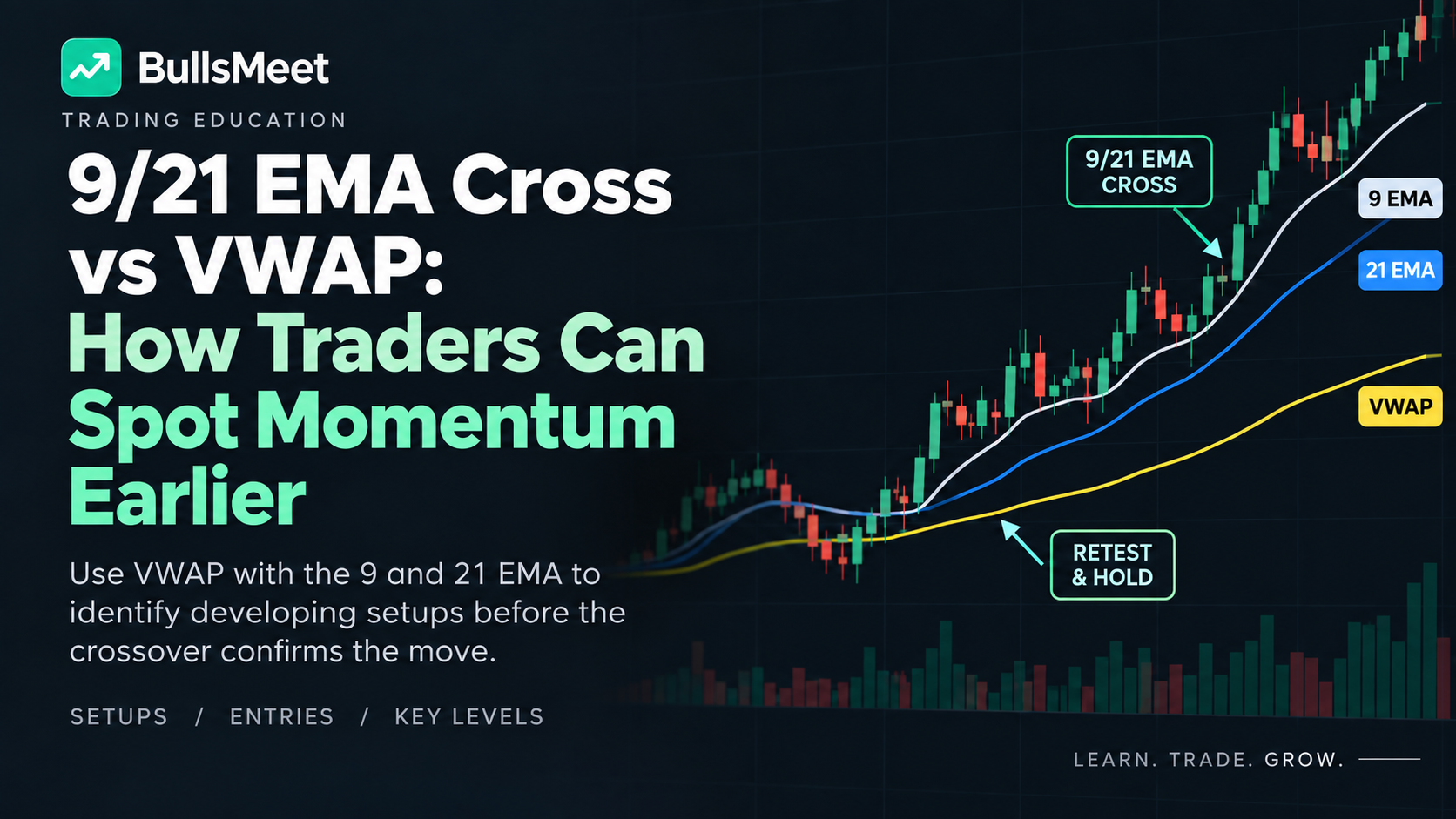
The 9 EMA crossing above the 21 EMA is one of the simplest momentum signals traders watch.
But there is one problem: by the time the crossover happens, part of the move may already be underway.
That doesn't make the 9/21 EMA cross useless. Instead, the crossover can work better as confirmation of a developing setup rather than the only reason to enter a trade.
One tool traders can watch alongside the EMAs is VWAP — Volume Weighted Average Price.
The 9/21 EMA Cross Might Be Too Late 👀
The key isn't blindly buying a crossover. It's understanding where the setup may be developing before the lagging confirmation arrives.
What Is the 9/21 EMA Crossover?
The 9-period exponential moving average reacts relatively quickly to recent price movement, while the 21 EMA moves more slowly.
When the 9 EMA crosses above the 21 EMA, traders often interpret it as a sign that short-term momentum is strengthening relative to the recent trend.
9 EMA below 21 EMA → momentum improves → 9 EMA crosses above 21 EMA
The crossover can be useful confirmation.
But moving averages are calculated using previous price action, which means they naturally lag price. Sometimes a stock has already made a meaningful move before the crossover appears.
Where VWAP Can Give an Earlier Clue
VWAP represents the average price an asset has traded at during the session, weighted by trading volume.
Many intraday traders use VWAP as a reference point for whether price is showing relative strength or weakness during the session.
Instead of waiting exclusively for the EMA crossover, a trader can also watch how price behaves around VWAP.
This can be an early indication that intraday strength is developing.
Instead of chasing the initial move, the pullback gives traders an area to observe.
If buyers defend the area and price begins moving higher again, the setup may be gaining strength.
The EMA crossover can then become additional confirmation rather than the first indication that something is happening.
The Sequence Traders Are Watching
↓
Price retests VWAP
↓
VWAP holds
↓
Price begins making higher lows
↓
9 EMA crosses above 21 EMA
↓
Momentum confirmation
The important distinction is that the trader isn't blindly buying because two moving-average lines crossed.
Instead, they're watching how price structure develops around an important intraday reference level first.
Why Waiting Only for the EMA Cross Can Be Late
Imagine a stock begins moving around $50.
It pushes through VWAP near $50.20, pulls back, holds the area and then starts accelerating.
By the time the 9 EMA finally crosses above the 21 EMA, the stock could already be trading significantly higher.
Someone watching only the crossover may therefore see the setup later than someone already monitoring:
- VWAP positioning
- The pullback
- The retest
- Price structure
- Volume
- Momentum
The EMA crossover can still be valuable — but in this framework it serves primarily as confirmation.
Don't Buy Every VWAP Retest
VWAP isn't guaranteed support. A stock can move above VWAP and immediately fail.
That's why context matters. Before treating a VWAP retest as a potential setup, traders may also look for:
- Increasing volume
- Higher lows
- Strong relative volume
- A catalyst behind the move
- Broader market direction
- Nearby resistance
- Clean price action around VWAP
If price loses VWAP aggressively after the retest, the original setup may no longer be valid.
The Bigger Lesson
The takeaway isn't:
And it isn't:
The goal is to understand the sequence behind the indicator.
Indicators should help explain what price is doing. They shouldn't replace price action, risk management or a trading plan.
A crossover can tell you momentum has changed. Watching the setup develop beforehand can help you understand why it changed.
Want More Setups Like This?
Inside BullsMeet Market Edge, we break down trading setups, potential entry areas, important levels and the reasoning behind them — not just ticker alerts after the move has already happened.
Explore BullsMeet Market Edge →Learn the setup. Understand the levels. Build your own thesis.
Disclaimer: This content is provided for educational and informational purposes only and is not financial advice. Trading and investing involve risk. Always do your own research and manage risk appropriately.